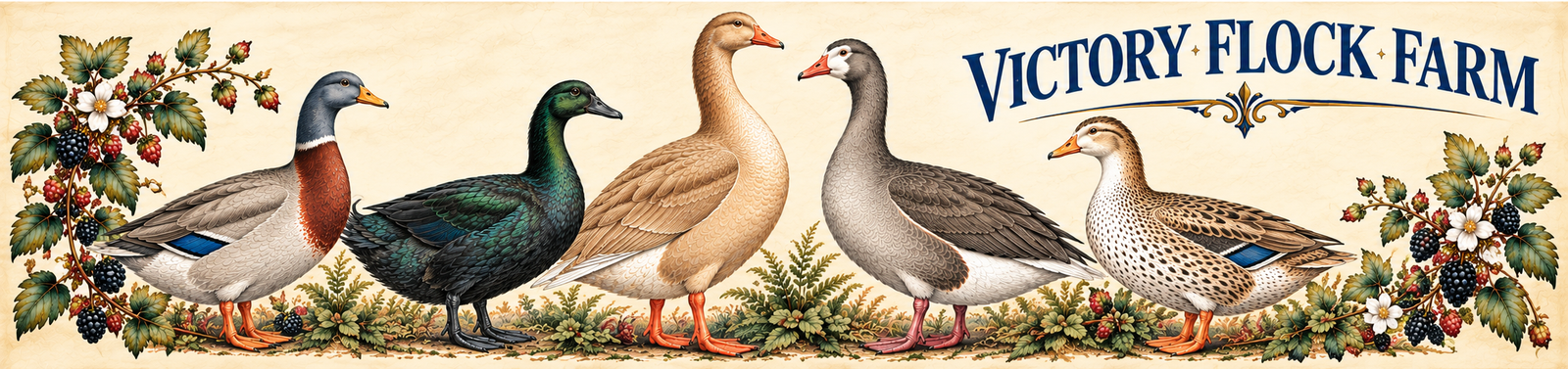
Pastured Waterfowl
Unlike standard commercial poultry confinement yards, our purebred waterfowl live dynamic, active lives integrated directly into our regenerative orchard ecosystem. Moving through our 8-cell geometric rotation layout, our birds find deep refuge from the summer heat under a lush fruit tree canopy. This lifestyle creates a self-harvesting forage loop of grasses, bugs, and windfall fruit. When combined with our homegrown high-anthocyanin grain rations, it naturally balances fat deposition, develops rich muscle texture, and delivers an unmatched culinary table experience.
Explore Our Heritage Foundations
RESTORING AMERICA’S PREMIER HISTORICAL TABLE DUCK
The Slow Food Ark of Taste Foundation Sovereign
Primary Culinary Purpose: Whole-Carcass Traditional Roasting Duck (9-Week Broiler / 12-Week Holiday Finish)
Long before Pekin ducks arrived on American shores from China in the late 19th century, the iridescent, beetle-green Cayuga reigned supreme as the ultimate heavy meat bird of the traditional American table. The true origins of this native breed are steeped in early New York lore, tracing back to a pair of wild black ducks captured by a local miller on a millpond in Dutchess County in 1809. The descendants of those original pinioned birds multiplied and spread to Orange County, where their superior frame broadness caught the eye of an astute agriculturalist named John S. Clark.
Circa 1840, Mr. John S. Clark obtained a group of these distinctive deep-bodied birds and introduced them to the Finger Lakes region of Cayuga County, New York. Clark meticulously selected his foundation flocks, noting early on that some of the birds occasionally produced a unique "top-knot" crest on their heads. Named in honor of the indigenous Cayuga Nation (Gayogo̱hó:nǫ’) of the Haudenosaunee Confederacy—whose name translates beautifully to "People of the Great Swamp"—this breed represents one of the few domestic waterfowl lines to originate purely on North American soil. Its deep genetic roots trace directly back to the wild American Black Duck (Anas rubripes), a native species historically managed, protected, and pinioned across northeastern wetlands by indigenous caretakers long before European contact. Today, this ancestral lineage is actively honored by contemporary Indigenous culinary traditions, including chefs within the Seneca-Cayuga Tribe, who celebrate the bird's rich heritage and deep-rooted place in authentic American foodways.
To scale the bird into a robust commercial asset, early regional breeders crossed Clark's foundational lines with the French Rouen to drastically increase body size and meat yield, and the Black East Indian to solidify the deep, glossy beetle-green iridescence of its plumage. Clark’s birds quickly exploded in popularity across northeastern markets for their rapid early frame development, exceptional hardiness, and unparalleled table qualities.
The Historical Credentials & Timeline
The historical credentials of the Cayuga are firmly woven into early American agriculture:
- In 1851, Luther Tucker, the influential editor of The Cultivator, heavily documented the superior weight benchmarks of the "Black Cayuga," validating it as an exceptional meat bird for discerning tables.
- In 1853, at the Maryland State Agricultural Society Show in Baltimore, Cayugas were judged strictly on their robust utility traits, carcass attributes, and deep skeletal frames.
- In October 1863, prominent agricultural author Caleb N. Bement published the definitive Civil War-era exposition on the breed, titled “Cayuga Black Duck—Its History, Origin, &c.” simultaneously across the Atlantic.
Bement praised the Cayuga's extraordinary ability to thrive through brutal winter freezes, its quiet demeanor, and its rich, high-quality, dense dark meat—firmly establishing it as a prized farm asset a decade before its official acceptance into the American Poultry Association's first Standard of Perfection in 1874, surging to become the country's primary commercial choice for regional poultry markets during the entire second half of the nineteenth century.
The 1940s Home-Front Guardians & The Ark of Taste
By the mid-20th century, the rise of industrial factory processing forced the Cayuga off massive commercial operations in favor of the white-feathered Pekin. Because Cayugas carry dark down feathers, their carcasses are more labor-intensive to pluck cleanly by machine—an aesthetic prejudice that nearly drove the breed to extinction.
During the dark wartime years of the 1940s, the breed experienced a vital homesteading renaissance. Prized by backyard self-sufficiency growers and dedicated American Poultry Association (APA) exhibition selectors for their quiet demeanor, fierce predator awareness, and legendary cold-hardiness, these mid-century guardians carefully maintained the breed’s heavy, broad-breasted utility carriage against intense industrial decay. This strict lineage preservation is exactly why the Cayuga duck has been officially elected into the prestigious Slow Food USA Ark of Taste—an international catalogue dedicated to rescuing endangered regional specialties that carry exceptional cultural and culinary value.
The Culinary Profile
“Although it is difficult to clean and prepare, it has very high quality meat with an intense beefy flavor. The breast, while smaller than that of other more conventional duck breeds, produces a succulent deep red meat with a complex taste.”
— Official Listing, Slow Food International Ark of Taste
Because our young ducks spend their days actively rotating through our shaded grove, their intense foraging habits yield a complex, slightly gamey richness. Their frame is naturally more compact than today’s greasy, fast-grown commercial ducks, producing a far firmer and cleaner subcutaneous fat distribution.
During the Civil War era, heavy heritage meat ducks like the Cayuga or the Rouen were rarely broken down into separate cuts; they were always roasted whole to showcase the breast frame and capture the rich, melting fat. To recreate an authentic 1860s presentation for your Cayugas, this traditional method represents standard American and English cookery of that period with our traditional Roasted Duck with Sage and Onion Stuffing.
WARTIME RATIONING AND THE PURSUIT OF "THE IDEAL DUCK"
Engineering the Ultimate Utility Breed
Primary Culinary Purpose: Artisanal Cured Small-Batch Charcuterie, Breakfast Bacons, & Gourmet Hams (9-Week Griller / 12-18 Week Smokehouse Finish)
The legendary Reginald Appleyard of Priory Farm in England was the master breeder behind the Silver Appleyard duck. Throughout the 1930s, Appleyard focused his immense breeding expertise on solving a massive operational bottleneck plaguing the European waterfowl industry. By that era, traditional Aylesbury ducks were becoming increasingly delicate due to intensive commercial over-breeding, while the old utility Rouen ducks from France had transformed into massive, slow-moving, lumbering exhibition birds that were no longer practical for real farm use.
Though his groundbreaking breed was highly celebrated, its early momentum collided with the outbreak of World War II. Because he was already a mature man in his 50s at the start of the conflict, records indicate that Appleyard did not personally fight on the front lines, remaining instead at Priory Farm to operate his critical agricultural supply hub. However, he served his country aggressively on the home front as an invaluable agrarian defense asset—authoring vital food survival guides and shipping his heavy, high-fat meat birds to British families facing starvation under Germany's strict naval blockades. While managing this essential home guard lifeline, the Appleyard family paid an immense wartime price: his eldest son, Major John Geoffrey Appleyard, a highly decorated British commando and legendary early Special Air Service (SAS) pioneer, was tragically killed in action over the Mediterranean in 1943.
The Master Genetic Blueprint
To revitalize the table duck, Appleyard meticulously crossed three foundational breeds:
- The Rouen: Sourced for its broad frame and rich, beef-like meat quality.
- The Aylesbury: Sourced for its rapid early growth and pristine, pale white skin.
- The Pekin: Sourced to inject high egg-laying stamina and excellent feed conversion.
His goal was to engineer a high-yield dual-purpose bird that could grow rapidly while remaining active enough to forage aggressively across pasture without losing its heavy egg-laying capabilities.
Pre-War Utility Records
Original Priory Farm brochures show that Appleyard hit his utility targets perfectly. By 1939, his original stabilized lines achieved a phenomenal processing milestone: by 9 weeks of age, a young Silver Appleyard reliably produced a cold, cleanly plucked 3 kg (approx. 6.5 lb) table bird boasting an unparalleled meat-to-bone ratio. This rapid, heavy growth made the breed an instant commercial prize, winning top accolades at the London Dairy Show and the Bethnal Green exhibitions.
Post-War Survival & The "Liquid Gold" of Rationing
Though the breed was highly celebrated, World War War II broke out shortly after its development, and subsequent post-war poverty nearly decimated heritage waterfowl numbers across Britain. Operating his critical agricultural supply hub at Priory Farm, Reginald spent the war years aggressively promoting his duck as an essential home-defense lifeline for a rationed nation. Because sugar, butter, and lard were strictly restricted under enemy blockades, the Appleyard provided families with meat, large white eggs, and an abundance of rich skin fat that home cooks meticulously rendered down as "liquid gold" to replace scarce cooking oils.
While serving his country dynamically on the agricultural home front, the Appleyard family paid an immense, heartbreaking wartime price. His brilliant eldest son, Major John Geoffrey Appleyard—a highly decorated British commando, legendary Special Air Service (SAS) pioneer, and close comrade of secondary special forces development—was tragically killed in action during an airborne mission over the Mediterranean in 1943.
"Our goal is to make a beautiful breed of duck, with a combination of beauty, size, lots of big white eggs, white skin, and a deep, long, wide breast."
— Post-WWII Promotional Leaflet, Priory Waterfowl Farm
Reverse-Engineering a Living Standard
Because Appleyard remained in a constant state of breeding experimentation and fine-tuning up until his death in 1964, he was so focused on utility perfection that he never took the time to write down an official, rigid breed standard. To prevent the breed from fading into obscurity, the British Waterfowl Association had to completely reverse-engineer the breed's standard from a famous 1947 oil painting of Appleyard's original prize-winning birds painted by animal artist Ernest George Wippell. With this painting as their map, the official breed standard was finally codified in 1982.
The VFF Culinary Profile
While the Silver Appleyard is an energetic, active forager that keeps from laying down the excessively oily, fat layers typical of modern commercial Pekins, it still produces the highest volume of premium rendering fat of any breed offered in our Victory Larder catalog.
Because sugar was heavily rationed during the mid-20th century, traditional Suffolk cooks learned to slice through the succulent skin fat of a whole Appleyard roaster by stuffing the cavity with sharp, sour orchard fruits like tart cooking apples and wild plums. When roasting an Appleyard today, we recommend saving every drop of the pooling, clear pan juices—preserving that traditional, clean liquid gold as a healthy, high-end cooking fat for your winter larder. To test this culinary profile on your own table, pair it with our traditional Roast Duck with Savoury Apple & Prune Stuffing.
THE HEAVYWEIGHT ORCHARD DUCK OF CHEMNITZ
Engineering the Sovereign "Duck Steak" Variant
Primary Culinary Purpose: Thick-Cut Pan-Seared "Duck Steaks" & Dense Boneless Breasts (12-Week Mature Pasture Grow-Out Only)
In the German state of Saxony, near the town of Chemnitz in 1930, a masterful poultry innovator named Albert Franz set out to engineer a premium, heavy dual-purpose duck. He officially introduced this striking pastel-plumaged creation to the world at the landmark Saxony Show of 1934, giving the breed its name. Franz was fiercely opposed to the emerging industrial model of zero-pasture factory confinement barns where birds were crammed indoors and spoon-fed intensive grain. Instead, he envisioned a highly efficient commercial model for the low-input, diversified family farm—a system where the landscape itself did the financial work.
Parallel Paths of the Great Masters
The story of the Saxony is inextricably linked to the broader, pre-war European movement to save the traditional farmstead. On opposite sides of the impending global conflict, two fiercely dedicated poultry artisans—Albert Franz in Germany and Reginald Appleyard in England—were fighting the exact same battle. Both men watched with deep concern as the emerging industrial poultry model began pushing birds into zero-pasture, grain-dependent confinement factories. Both masters spent the 1930s executing brilliant genetic blueprints to create the perfect, low-input, self-harvesting farm asset. They envisioned a highly efficient commercial framework where the landscape itself did the financial work, and where active pasture athletes could clear out orchard pests and convert raw grass directly into uniform table meat.
The Master Genetic Blueprint
To achieve his vision of "foraging commercialism," Franz meticulously crossed three ancestral lines to eliminate their distinct biological liabilities:
- The German Pekin: Sourced to lock in a massive, wide-breasted heavy skeletal framework, while rewriting its metabolism to convert pasture and insects into dense red breast muscle instead of flabby, oily grease.
- The Rouen: Sourced for its rich, beef-like meat pigmentation, while crossing it with lighter plumage lines to breed out the dark under-skin color. This ensured the Saxony possessed a pale down undercoat that plucked entirely clean without leaving dark pin-feather stains.
- The Blue Pomeranian: Sourced to pour unrivaled pasture vitality, cold-hardiness, and an aggressive hunting drive directly into a massive heavy-class body structure.
Wartime Obliteration and the 1952 Renaissance
Just as the Saxony began gaining traction across Europe, World War II broke out, devastating the breed's progress. Like millions of ordinary German citizens, Franz was conscripted into regular military service to defend his country, eventually being captured and held inside a Prisoner of War (POW) camp. While he was incarcerated, the Allied bombing of Chemnitz and the brutal ground fighting completely obliterated the local landscape; his pre-war foundational flocks were entirely scattered or slaughtered for food.
Upon his release, Franz returned home to absolute ruin under the strict regulations of Soviet-occupied East Germany. Refusing to let his life's work vanish, Franz began a quiet, tireless search in 1952. He walked from village to village across the Saxony countryside, knocking on doors to track down the few scattered, half-blood descendants that local peasants had hidden from starving armies. Reintroducing his original ancestral blueprint, he systematically rebuilt the breed from scratch. His sheer dedication forced official state recognition in East Germany in 1957, followed by West Germany in 1958. The breed was brought to the United States in 1984 by leading waterfowl expert Dave Holderread, before finally being admitted into the American Poultry Association's Standard of Perfection in 2000.
Processing Milestones & Dressed Benchmarks
Because the Saxony is built on a massive skeletal framework, its processing milestones line up precisely with its natural feathering cycles to optimize farm workshop labor:
- The Harvesting Window: The optimal harvest window lands exactly at 12 to 12.5 weeks of age. This timeline catches the juvenile ducks right after their adult feathers have completely matured but just before they hit their secondary body molt, completely eliminating the headache of wrestling with unpluckable pin feathers.
- Live Weight at Slaughter: At 12 weeks of age, a well-foraged heritage Saxony scales at a live weight of 7.5 to 8.5 pounds.
- The Dressed-Out Weight: When processed as a whole, clean bird, it yields a robust, oven-ready carcass weighing 4.3 to 5.2 pounds.
The Victory Larder Culinary Profile
Because many modern exhibition lines have run dangerously undersized, our program selects strictly for massive, wide-set breast frames to restore the bird's true historical mature weight standard. Unlike the Cayuga or Appleyard, we do not treat the Saxony as a whole roaster, nor do we break it down for curing fat.
Instead, we fulfill Albert Franz's exact ancestral vision, growing our Saxonies out to a full 12-week window on an active paddock rotation. This deliberate exercise keeps the bird lean and develops a remarkably dense, fine-textured, ruby-red breast muscle with next to no flabby grease. When taken off the bone as a raw breast, trimmed, and dry-aged, the meat loses its waterfowl gameyness, presenting an intense savory richness that cooks, slices, and tastes exactly like a high-end, thick-cut beef ribeye steak. To experience this premier culinary revival, pair it with our pan-seared recipes over on the Artisanal Cast-Iron Field Notes Page.